-
- Note:
- These articles and images are copyrighted and may not be reprinted, re-used, reposted, copied, or otherwise distributed without permission from the author.
Disclaimer:
You should not rely on the veterinary advice or information provided on this site for diagnosis or treatment of any specific situation. Always consult your own veterinarian for specific advice concerning the medical condition or treatment of your own pet or animal.
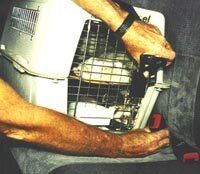 - Buckle your carrier in the back seat
-
-
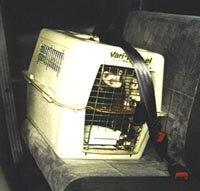 - Seatbelt goes through the carrier handle
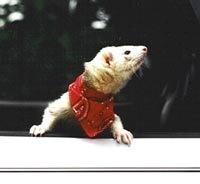 - Enjoy the ride!
All photos © John Porter
|
- ROAD TRIP! FERRETS IN THE CAR
© Erika Matulich
- Occasionally you will need to take your ferret on a trip in the car. This could either be a short trip to the veterinarian, or a longer vacation trip. In general, ferrets travel easily by car. Some ferrets may claw at the cage, which is why trimmed nails are important. Most will sleep, especially if you keep the sound turned off any rear stereo speakers. Never tranquilize a ferret for travel. It is dangerous and unnecessary.
-
- Carrier Confinement
- Your ferret should always travel in a secure carrier and never run loose in the car! I took my first ferret, Critter, home in a petstore cardboard box. It took only a few minutes for the little escape artist to get out and start exploring the car. She crawled under the brake pedal and I was faced with the possible agonizing choice of stepping on the brake and squashing the ferret or not stepping on the brake and crashing into something! I finally pushed her out of the way with my foot, but before I could pull over she squeezed behind the dashboard. It took 30 agonizing minutes to get her out! My very next purchase was an airline-approved carrier. These are the sturdiest, and you won’t have to make another carrier purchase if you decide to fly with your ferret. Soft-sided carriers are okay for very short trips. And even though you have your ferret in a carrier, ferret-proof your car just in case of an escape. Duct tape can seal those gaps between the floorboard and dash.
-
- Buckle Up!
- When you place your carrier in your vehicle, be sure to secure it in a seat. Most often you can take the shoulder harness, run it through the handle of the carrier, and buckle it in. A lap belt might also work, depending on the size of your carrier. Another alternative is to use bungee cords to attach the carrier to the headrest of the seat. For very large carriers I have used rope or nylon dog leashes tied all the way around the seat and carrier. For the ferret itself, make sure you have a harness and leash in case you need to remove the ferret from the carrier. An ID tag is also helpful.
-
- Beat the Heat
- In the summer, car travel is particularly dangerous because of heat hazards. Remember that ferrets cannot tolerate temperatures above 85 degrees F (29EC). NEVER leave your ferret in a parked car during the summer, even if the windows are open and it is just for a few minutes -- interior car temperatures can double in as few as ten minutes. There are too many sad storied about ferrets dying after staying in a parked car for "just a minute." So the most important thing to remember about ferret car travel is keeping your ferret cool. Don’t put the carrier on the car floor where it is hottest; place the carrier on the seat. Block direct sunlight from car windows by rolling up the window on the edge of a towel that hangs down, or taping cardboard against the window. Even if your car has airconditioning, your car could overheat, your airconditioning could break, or your car could break down and help would take time to arrive. You should always carry emergency cooling supplies with you, as well as water.
-
- Supplies
- Even for the shortest summer trips, take along frozen water bottles to put in the carrier. Be sure the ferret does not have direct contact with the cold surface, so wrap the frozen bottle in a towel or sock. Always carry water with you and give your ferret access to water. I had my airconditioning fail during a trip (it was almost 100 degrees outside). Fortunately, I had some gallon jugs of water in the car and I wet down the ferrets with a towel and let air from the open windows blow over the ferrets to help with evaporative cooling until we got home. In a similar situation, your could also use a water sprayer, or dunk your ferret in a bucket of cool water. Instant cold packs can also be used in an emergency.
- For trips longer than an hour or two, pack food, treats, extra water bottles (full), paper towels, and litterbox materials. Don’t deprive your ferrets of food and water because you are afraid of them throwing up! Ferrets rarely get motion sickness, and their fast metabolisms require food and water every few hours. The problem is that if you load up their carrier with food and water, the ferrets make a big mess digging and splashing! Only put a small amount of food in the cage at a time. Offer water every hour. Clean out the litterbox or cage liner at every rest stop before odors build up or your ferret gets soiled.
-
- Drive On!
- I hope these tips help you with your next ferret car trip. Buckle up and keep cool!
|